Background and Rationale:
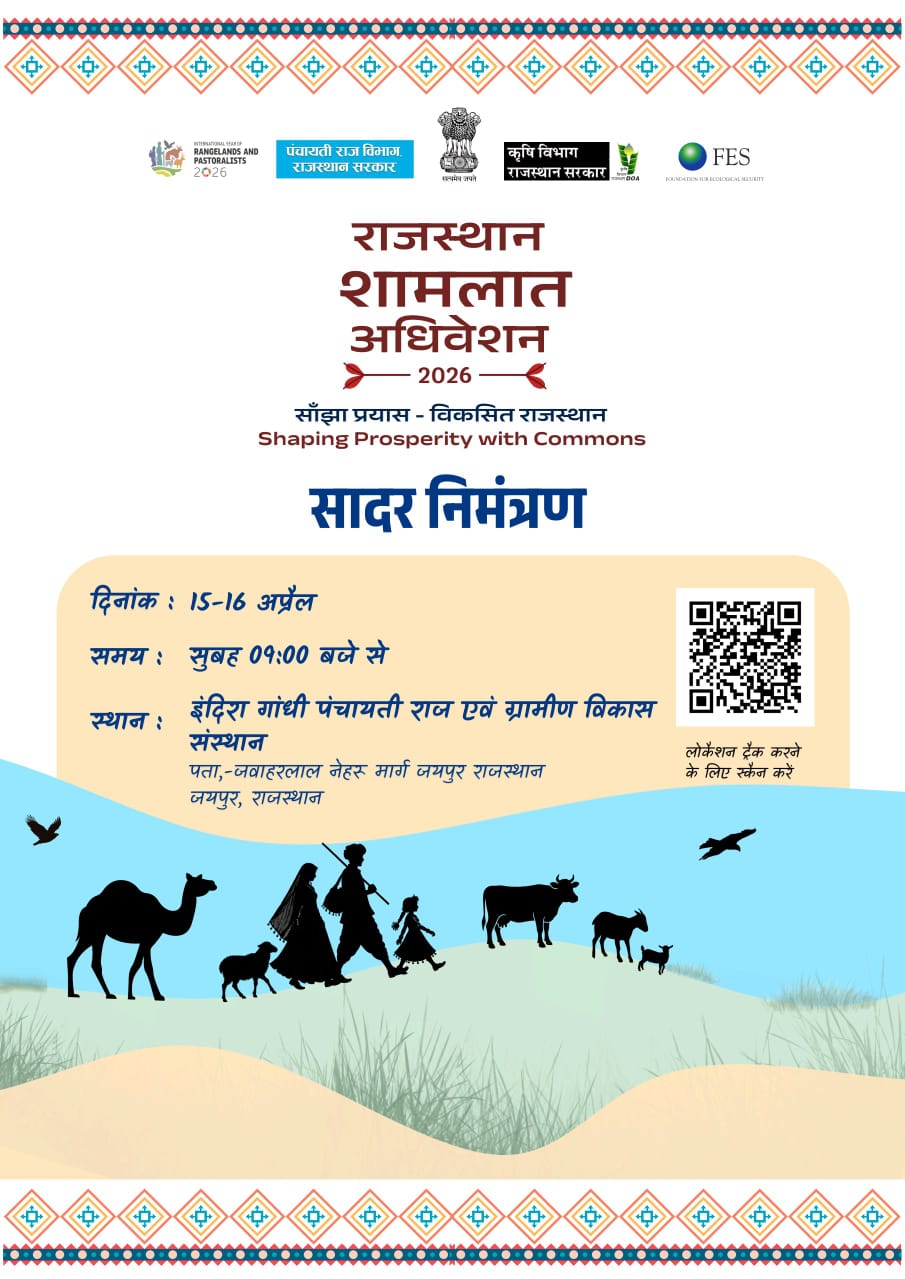
A Common Convening / Shamlat Adhivesion is proposed on the theme “Shaping our Prosperity with Commons”. This will be an opportunity for Enhancing the Visibility of Common Resources and its contribution in strengthening Resilient Rural Livelihoods and sustainable management of Local Ecosystems.” The convene aims to create a multi-stakeholder platform to deliberate on the critical role of commons in addressing challenges related to climate change, land degradation, and rural livelihoods.
The year 2026 has been recognized as the International Year of Rangelands and Pastoralists, which recognizes the importance of commons such as pasturelands (rangelands), local water bodies, wetlands, forests, and governance and management systems in sustaining rural livelihoods and fostering sustainable food systems, economies and ecosystems. In this context, there is an urgent need to promote sustainable, community-driven approaches that strengthen Natural Farming practices and improve governance of common resources.
Objective of the Commons Convene
- To bring together diverse stakeholders including government departments, practitioners, academicians, civil society organizations, women, youth, and community representatives
- Celebrate International Year of Rangelands and Pastoralists (IYRP) by deliberating on the role of commons and rangelands in mitigating climate impacts, food- fodder-water security, and sustainable livelihoods
- To deliberate on the role of commons in climate resilience, food security, and sustainable livelihoods
- To share field experiences, best practices, innovations and policy perspectives
- To identify scalable models integrating Natural Farming and commons governance
- To facilitate dialogue for policy convergence and institutional strengthening
Key Focus Areas
- Agriculture & Commons: Climate change mitigation and food security (Natural Farming & Commons)
- Pastures and Panchayats Re-imaging the restoration of rural ecosystems IYRP 2026
- Waterbodies, wetlands, and ecological interface for Viksit Rajasthan
- Commons, culture, and traditional systems (Orans, Devbani)
- Aravalli landscape and ecological restoration
- Ecological services and environomics of commons
- Role of MGNREGS and watershed programs in commons development
- Forest Rights Act 2006 and Community Forest Rights (CFR)
- Commons-based livelihoods and value chains (e.g., Vanaspati Beej Bank initiatives)
- Role of women and youth in commons governance
Expected Outcomes
- Development of a jointly agreed “Way Forward” or Charter
- Policy recommendations for Integration of Commons land & water (Shamlat) into the Policy and Vision Document for Viksit Rajasthan
- Strengthened collaborative actions among stakeholders
- Documentation of best practices, innovations and scalable models
- Submission of recommendations to Government of Rajasthan, Government of India, and relevant national and international platforms
Key Departments and Stakeholders: Participation is expected from Government departments such as:
- Rural Development
- Panchayati Raj
- Agriculture
- Animal Husbandry
- Water Resources
- Civil society organizations, academic institutions, practitioners and community representatives.
- Representatives from agro-pastoral and pastoral Community and Community Institutions.
- Donor agencies
Tentative Details
Venue: IGPRS
Location: Jaipur, Rajasthan
Duration: 2 Days
Possible collaboration:
CmF, Sewa Mandir, PRADAN, ITC, JKBT, ATREE, CEEW, GIZ, DRC, IYRP, APF, Praytna Samiti, Jan Chetna, SPGVS, GVNML
Proposed Highlights of the Two-Day Convening
- Inauguration and exhibition: Launch of “Shamlat ki Gatha” (Success stories from Grassroots & Exhibition of Produce of Commons)
- Plenary on IYRP & Context of Rajasthan and Commons
- Thematic panel discussions followed by debriefing sessions on key issues
- Experience sharing and case studies, guftugu
- Stakeholder dialogue and Panel Discussions with representatives from government, departments, Academicia, Researchers, Practitioners, etc
- Theatre centre staging on commons
- Development of a jointly agreed Way Forward / Charter
For More details :
Mr Shantanu, Foundation For Ecological Security
e- mail : shantanu@fes.org.in
Phone: 9460376236
P.Vivekanandan, Chair, International Year of Rangelands and Pastoralists 2026 - South Asia
77088532334