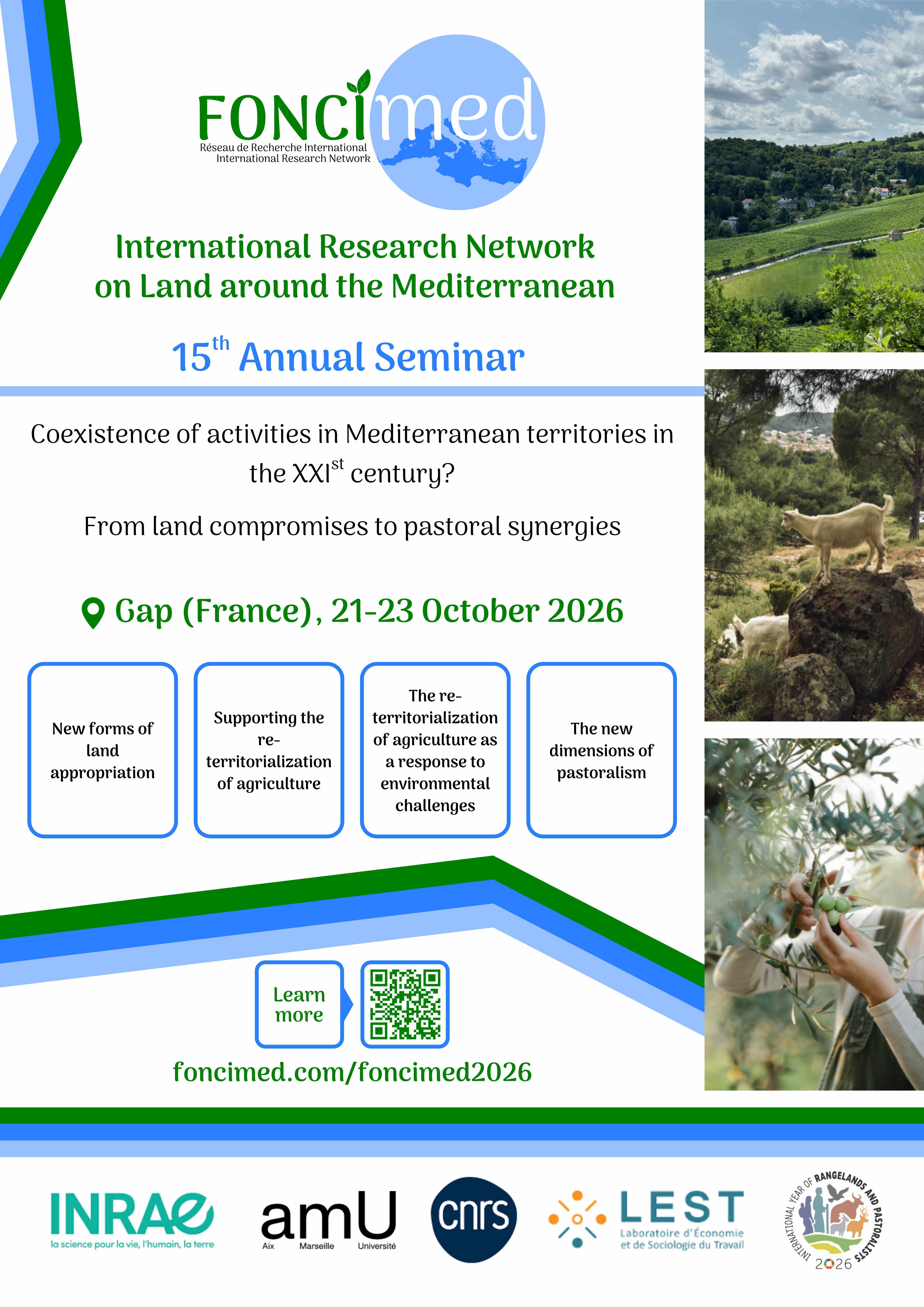
Welcome to the 15th Annual Seminar of the FONCIMED International Research Network on Land around the Mediterranean that will take place on 21/23 October 2026 in Gap, France.The seminar will take place over three days, with an inaugural conference opening two days of presentations structured around the four research focuses outlined above. The third day will be devoted to a field visit. Four amazing keynote speakers will highlight the Conference:
- Juliette KNOCKAERT, archeozoologist, CNRS, France
- Kelly HOPPING, ecologist, Boise State University, ID, USA
- Mohamed JAOUAD, agricultural economist, INAT, Tunisia
- Pablo MANZANO, environmental sciences, Basque Centre for Climate Change, Spain
Background of the Seminar
Several demands for land use, sometimes conflicting, are expressed within Mediterranean territories. They reflect contemporary societal changes, which affect territories that are multifunctional by nature. Characterized by accelerated climate change, Mediterranean mountains, where pastoral and tourist activities coexist but whose viability is now uncertain, are seeking solutions to adapt. Livestock farmers, guardians of pastoral systems often considered as centuries-old heritage, are facing new challenges in their effort to preserve pastures (pastureland modification of pastures, new zoonoses, predators, more frequent and more disastrous fires). Alongside, the tourism sector, a high value-added activity sometimes part of international service markets, is exploring new development pathways in response to uncertain snowfall. Furthermore, the role of pastureland for fire risk prevention is often barely acknowledged. In addition, new uses, particularly for green energy production, are competing with existing ones. Finally, the need for intra/inter-territorial mobility is also increasing, exacerbated by more limited access to land.
The articulation of these various demands characterized by different spatial scales, time frames, and administrative levels complicates the emergence of compromises that are essential to the viability of these territories and to the implementation of virtuous synergies that may improve their habitability. On the contrary, controversies, tensions, and conflicts seem to increase rapidly. While external constraints are manifold (accelerating climate change and biodiversity loss, heightened international competition, increased socioeconomic inequalities, and geopolitical conflicts), there are also strong internal pressures (demographic transitions, resource scarcity).
Many questions, generally based on the need to reconcile the different perspectives of the various stakeholders, arise at the territorial level, including in particular:
- Reconciling socio-economic development and environmental preservation;
- Maintaining traditional activities and integrating modern activities;
- Improving rural liveability and seeking territorial competitiveness;
- Balancing allocation of means of production and distribution of resources.
The many rural challenges, whose non-exhaustive list detailed above might be expanded, actually call for an in-depth examination of the territorialized political regulation of market mechanisms as well as the dynamics of the emergence of local social innovations that are necessary to meet the needs of rural populations in their specific socio-ecological and socio-technical contexts. In this context, sharing experiences and international cooperation can be beneficial for the socially sustainable development of Mediterranean territories.
Communications may deal with the following research issues
- New forms of land appropriation;
- Supporting the reterritorialization of agriculture;
- The re-territorialization of agriculture as a response to environmental challenges;
- The new dimensions of pastoralism.